Document Metadata Remover —Clean Word, Excel & PPT Free
Remove the hidden Author, Company and revision data stored inside your Word, Excel and PowerPoint files. This document metadata remover works entirely on your own device, so the file you clean is never uploaded to a server.
- Word, Excel & PPT
- No Upload, No Sign-up
- 100% Free & Secure
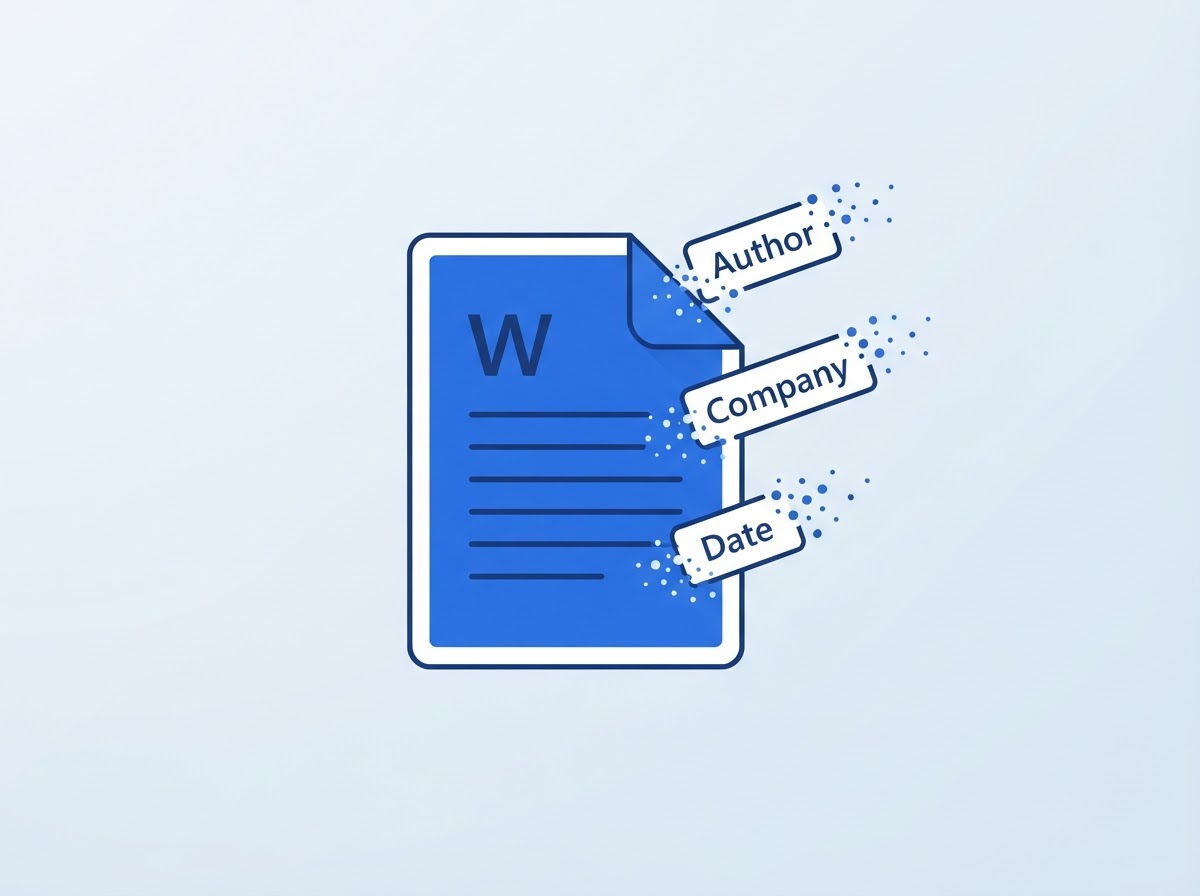
Document Properties
- Author:
- Alex Morgan
- Company:
- Acme Consulting
- Modified By:
- Jordan Lee
- Revision:
- 4
Your privacy,
our priority
Metadata Removed
- Author & Last Modified By
- Company & Manager
- Keywords & Category
- Custom Document Properties
Full Metadata Report
What This Document Metadata Remover Deletes
Every property the scanner finds, and what each one gives away.
A Word, Excel or PowerPoint file is really a small ZIP archive holding the content you see plus a set of document-property files Office writes alongside it. This tool reads those properties, shows them to you, and then writes a copy with none of them. Here is what it looks for.
- Title, Subject & Comments — a document description typed in, or carried over from a template, independent of the visible filename.
- Author & Last Modified By — the name on the computer account that created the file, and the name of whoever last saved it — these can differ and both can be real identities.
- Company & Manager — the organisation name Office fills in automatically from its installation settings, even on a personal document.
- Keywords & Category — free-text tags, sometimes carrying internal project codes or client names.
- Revision number & dates — how many times the file was saved, plus exact creation and modification timestamps.
- Custom document properties — extra fields some organisations' templates add, such as a project code, client ID or internal status field.
Company and Author fields deserve a second look. Office fills both in automatically from the installation, often without the person typing ever noticing. Share a proposal built from a work template and your employer's name, plus your own, can travel inside the file even when you deliberately left both blank on the visible cover page — removing document metadata before you share is what keeps that out of files you intended to look anonymous or generic.
How to Remove Metadata From a Document (3 Steps)
About a minute, with no software to install.
The whole process runs on your own device. Nothing is sent anywhere, so there is no upload wait and no queue.
- Add your document. Drag a .docx, .xlsx or .pptx file onto the upload box above, or press Choose File to pick one from your device. You can also paste a document URL, or load a sample file to see the tool work. Files up to 20 MB are accepted.
- Review what was found. The scanner immediately lists the document properties embedded in your file — Title, Author, Company, Manager, Keywords, revision number and dates. Choose View Full Details for the complete field-by-field report, so you can see precisely what you were about to share.
- Download the clean file. Press Download Clean File. Your browser rewrites the document with those properties cleared, saved as yourfile-clean.docx (or .xlsx / .pptx). Your original stays untouched on your device.
The file's content — text, sheets, slides and formatting — is written back exactly as it was. Only the hidden document-property fields change.
Why This Metadata Remover Is Private
The design, not a promise.
Most "online" document tools upload your file to a server, process it there, and send it back. That means handing the very file you are trying to protect to someone else's computer. This tool takes the opposite approach: your browser does all the work.
The File API reads the document straight from your disk, and the open-source JSZip library unpacks and edits the document-property XML parts entirely in memory before repacking the clean copy. No request carrying your file ever leaves your device — which has four practical consequences:
- Nothing to intercept, because there is no upload in transit.
- Nothing to breach, because we hold no library of user documents.
- Nothing to take on trust, because we cannot delete what we never received.
- Nothing to wait for, because cleaning happens at local speed.
Closing or refreshing the tab discards everything. There is no account, no email field and no watermark, and advertising rather than subscriptions pays for the hosting. Our privacy policy sets out exactly what the website itself records, and the disclaimer covers the format limits honestly.
Supported Files & Limits
What works today, and the honest limits.
Word, Excel and PowerPoint (.docx, .xlsx, .pptx)
Fully supported. All three are Office Open XML packages sharing the same document-property structure, so one engine reads and clears the properties in any of them without touching the pages, sheets or slides.
Legacy .doc, .xls and .ppt
Not supported yet. These older binary formats store metadata differently and need a separate parser. Use Save As in Word, Excel or PowerPoint to convert to the modern format first, then clean the converted copy here.
File size
Files up to 20 MB are accepted. Because the work happens on your own device, the real ceiling is your available memory rather than a server quota, so a very large file may take a moment longer on an older device.
What does not change. Rewriting the document properties does not touch the content itself — text stays editable, formatting stays intact and formulas, sheets and slides are unchanged. The file size can shift slightly, since the underlying ZIP package is re-saved during cleaning.
Who Needs to Remove Document Metadata?
Five situations where it genuinely matters.
- Job seekers. A CV built from a template can carry a previous employer's Company name or a stranger's Author field without anyone noticing.
- Freelancers and agencies. Share a proposal or contract without exposing which client's template it was copied from, visible in Company or Manager.
- Legal and HR teams. Documents meant to be anonymised for a filing or process should not quietly carry a real name in Author or Last Modified By.
- Students and researchers. Submitting a paper or spreadsheet without a co-author's name or a supervisor's set as Manager lingering in the properties.
- Anyone redistributing a file. Forwarding a document someone else sent you also forwards whatever Author, Company and revision history they left in it.
For the wider picture — document, web and communication metadata, what the law says, and a test showing which fields actually survive processing — see our guide to metadata privacy and how to protect yourself.
Document Metadata Remover FAQ
Common questions about this tool.
Drop your .docx, .xlsx or .pptx file on the upload box above, review the metadata report it shows, then choose Download Clean File. The cleaned copy has its Title, Author, Company, Manager, Keywords and date properties cleared, along with any custom document properties.
Yes. There is no sign-up, no email required, no watermark added to your document and no cap on how many files you clean. Advertising pays for the hosting.
No. Reading and cleaning happen locally through the browser File API and the open-source JSZip library, so your document's bytes never travel over the network to us. Nothing is queued, logged or retained, and closing the tab discards everything.
Modern Office Open XML formats are supported: Word (.docx), Excel (.xlsx) and PowerPoint (.pptx). Legacy binary formats (.doc, .xls, .ppt) are not supported yet — save the file as its modern equivalent first, which most versions of Office can do from the Save As dialog.
It clears the core and extended document properties — Title, Subject, Author, Last Modified By, Keywords, Category, Comments, revision number, Company, Manager, creation and modification dates — and removes any custom document properties stored alongside them.
No. Only the hidden document-property fields are changed; the text, formatting, sheets, slides and layout are rewritten exactly as they were. The file size can shift slightly because the underlying ZIP package is re-saved.